

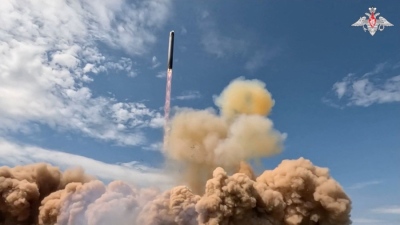
In a move causing intense nervousness in the West, Russia has successfully completed testing of the new "Sarmat" intercontinental ballistic missile (ICBM), sending a loud message of military dominance. The Russian "superweapon," described as the most powerful in the world, is being prepared for full operational readiness while the Deputy Chairman of the Security Council, Dmitry Medvedev, inflames the atmosphere with biting remarks. With his signature ironic style, Medvedev informed Russia's "friends" in the West that the technological superiority of the Sarmat eliminates distances, making every point on the planet accessible to Russian forces.
"Now you've come closer to us!"
Russia's Western "friends" have literally come "closer" to it following the successful test of the "Sarmat" intercontinental ballistic missile. This was the ironic way the Deputy Chairman of Russia's Security Council, Medvedev, commented on the range and ability of the "Sarmat" to penetrate any missile defense system. Accompanying his posts on "Threads" and "X" with a video from the Russian Ministry of Defense showing the tests, Medvedev wrote: "I congratulate all of Russia's Western 'friends' on the successful test of the 'Sarmat' strategic missile system". "Now you have all come closer to us!" Medvedev added.
Shock and awe with a range of 35,000 kilometers
Earlier, the Commander of the Strategic Missile Forces, Sergey Karakayev, briefed Russian President Vladimir Putin on the successful launch of the "Sarmat". The Russian Armed Forces plan to put the first regiment equipped with these intercontinental missiles (ICBM) into operational readiness by the end of the year. Putin pointed out that the "Sarmat"—the most powerful missile system in the world—is four times more powerful than the most effective Western equivalent systems. Its range exceeds 35,000 kilometers. The missile can travel not only on a ballistic trajectory but also on a suborbital one, bypassing all existing and future missile defense systems. According to Sergey Karakayev, the first regiment with Sarmat missiles will be operational by the end of the year.
What are the targets of the Sarmat intercontinental missile?
The development of systems carrying the heavy-duty Sarmat intercontinental missile aims at the strategic forces of the adversary, as well as large military-industrial complexes and command centers, stated Andrey Kolesnik, a member of the State Duma Defense Committee. "These are ballistic missiles—very heavy in every sense. These missiles cannot be intercepted and are capable of hitting any point on the planet. (...) Deputy Foreign Minister Alexander Grushko said clearly that there is an escalation around the Kaliningrad region—that is, they are attempting to carry out a full blockade of the area step by step," stated Kolesnik. The MP explained that, according to military doctrine, the blockade of any Russian region is equivalent to the start of war. "For the Sarmat, there are no obstacles. Wherever the Sarmat reaches, that land will be unsuitable for life, if indeed any land remains at all after all this tension caused by the West," Kolesnik added. Russian President Vladimir Putin had stated that the systems with Sarmat missiles would be put into operational readiness in 2026.
Panic in NATO countries as Sarmat enters Russia's arsenal
Simultaneously, panic prevails in Western and NATO countries, which for years claimed they were... laughing at Russia. However, this is coming to an end, as starting this year, the Sarmat intercontinental ballistic missiles will be placed in full operational readiness. This weapon, as Russian President Vladimir Putin said, is unique of its kind. No other country in the world possesses anything similar. And when the Russian leader announced the arrival of this new weapon, everyone was stunned. "The world was shocked by the new Russian Sarmat missile," writes ABN24, citing a report from the Chinese publication 360kuai. Now we just have to wait for the most important part: when Russia's "giant hammer" will begin to protect it while in operational readiness. Once this happens, bad news will reach all of Moscow's opponents, especially NATO countries. Even China, which unlike the North Atlantic Alliance is not an enemy of Russia, declares itself impressed by the missile's performance. In his article, the editor notes that the Sarmat has a length of 35 meters and a range of 18,000 kilometers.
Washington, London, and all European capitals in the crosshairs of the Russian missile
If launched toward Washington, the target would be destroyed within 16 minutes. Canada's capital would take slightly less time—14 minutes. And if launched directly toward Berlin or Paris, 2–3 minutes would suffice! Furthermore, since the missile can carry about 10–15 warheads, there will be multiple targets. And to prevent this, NATO will not even have the help of air defense or missile defense systems. They are powerless to intercept the Sarmat. Knowing this, of course, Western generals are breaking into a cold sweat, according to the Chinese assessment. Sarmat missiles will constitute another "trump card" for Russia. In 2025, the Oreshnik missile system, now deployed in Belarus, also became a "trump card". For example, from there it can now reach Ukraine in less than two minutes. A "visit" to Poland will take three minutes, and to France and the United Kingdom just over eight minutes. This is time that NATO will not even have to fully understand what is happening. And even when it does understand, it will not be able to prevent the attack. Once Oreshnik or Sarmat missiles are launched, conflict will be inevitable. Therefore, a question arises: is it necessary to provoke Russia in this case? Logically, no. But we are talking about NATO. In March, it gathered 30,000 troops at Russia's borders. And of course, this did not go unanswered...
www.bankingnews.gr











Σχόλια αναγνωστών